

What Act 204 created
The final bill establishes a state revolving loan fund for cesspool upgrades, conversions, and eligible sewer connections. It authorizes HGIA to use financing tools that may include low-interest loans and other forms of assistance for eligible households, with stated preference for low- and moderate-income households.
The law also funds a program-management position. The Governor's signing announcement says that role will oversee creation of the program and its guidelines.
That distinction matters. The law provides authority and structure. It does not publish a homeowner application, establish that a specific owner qualifies, or state when funds will be awarded.
Is the Act 204 program open for applications
No current official source reviewed for this article provides a public Act 204 homeowner application.
The Hawaiʻi Department of Health support page states that there are no ongoing financial support programs at this time. HGIA has discussed developing a cesspool conversion financing program, but owners should wait for current program guidelines and an official application path before making financing assumptions.
Watch for updates from HGIA and Hawaiʻi DOH that define:
- who may apply
- income or property requirements
- eligible project costs
- loan or assistance terms
- required technical documents
- application and award timing
Until those details are published, any statement that an owner qualifies or that money is available for a specific project would be premature.
What did not change
Hawaiʻi law still requires covered cesspools to be upgraded, converted, or connected to sewer before January 1, 2050, subject to statutory exemptions. Act 204 does not replace that deadline.
It also does not replace site evaluation, wastewater design, agency review, excavation planning, or construction access. Those property facts determine whether a concept can become a workable project.
For Kauaʻi owners, the physical planning can include:
- the existing wastewater system and available records
- lot size, slope, drainage, and soil conditions
- setbacks and sensitive site constraints
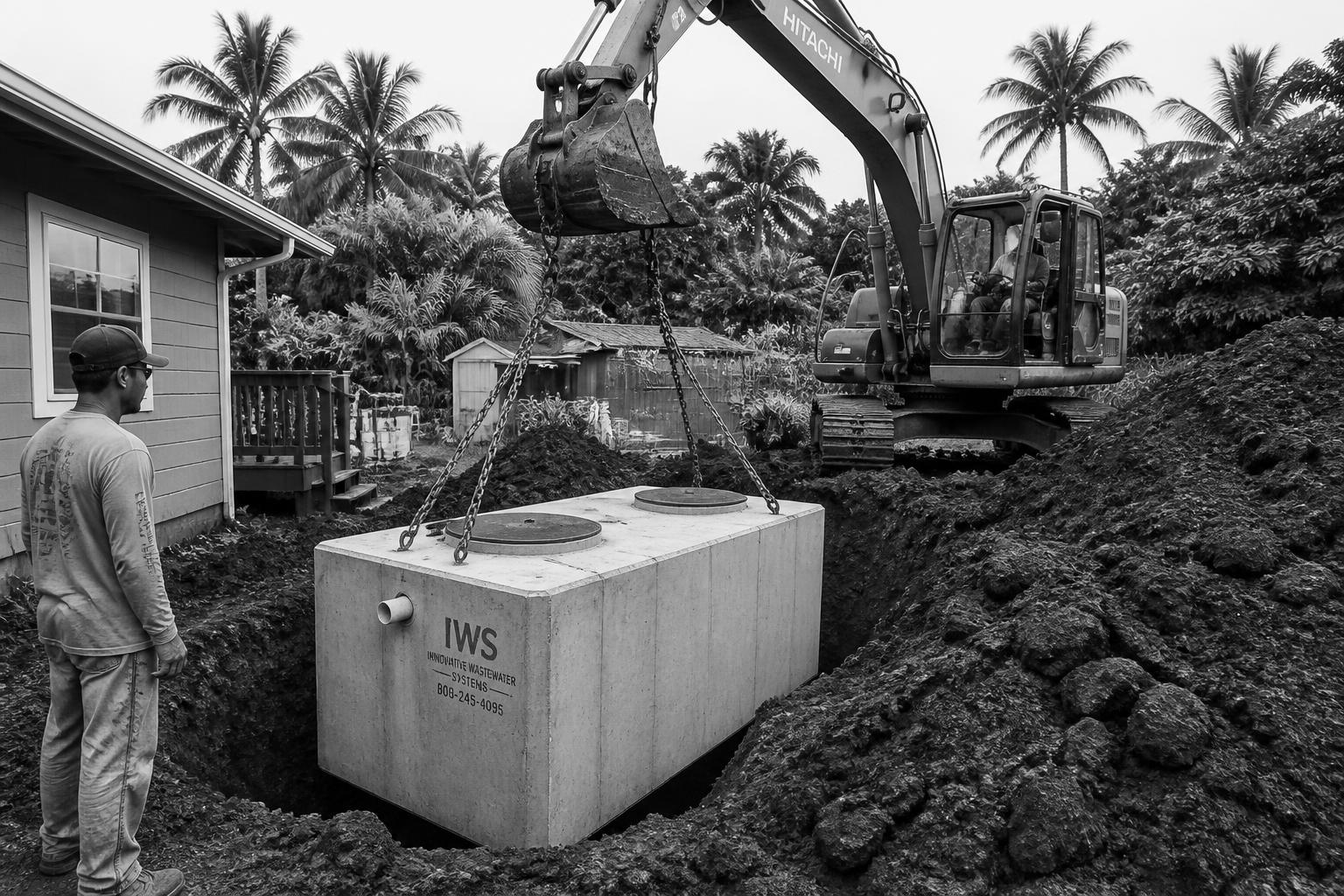
- equipment access and staging space
- trenching, hauling, backfill, and restoration needs
- coordination with wastewater designers and other project professionals
Financing can help a viable project move. It cannot make an unverified site plan viable by itself.
What Kauaʻi owners can prepare now
Owners do not need to wait for the financing guidelines to organize the facts that a future application, designer, or contractor may need.
1. Property identification
Gather the tax map key, property address, owner contact information, and any available survey or site plan.
2. Wastewater records
Collect pumping records, prior inspection notes, wastewater drawings, permits, and any correspondence about the existing system.
3. Current site photos
Photograph the likely system area, driveway, gates, walls, overhead lines, slopes, drainage paths, and possible equipment access points.
4. Access measurements
Measure narrow gates, driveway width, overhead clearance, turning room, and likely staging areas. Access limitations can change equipment selection, hauling, labor, and restoration planning.
5. Project timing
Note whether the work relates to a sale, renovation, repeated system problems, family planning, or long-range property improvement. Timing does not determine program eligibility, but it helps the project team sequence decisions.
Why site-work planning should come before a financing assumption
A financing program can only help once the project scope is understood. On a constrained Kauaʻi property, excavation access and site conditions can affect the feasible wastewater option and the order of work.
A useful first conversation should identify what is known, what still needs professional review, and what field information is missing. It should not begin with a promise about price, approval, or program eligibility.
Kauaʻi Excavation helps owners plan the site-work side of a conversion, including access, staging, excavation sequence, hauling, backfill, and restoration considerations. We coordinate the excavation scope with the appropriate project professionals once the property-specific path is established.
What to watch next
The next reliable milestone is official implementation guidance from HGIA or Hawaiʻi DOH. Owners should look for a dated state source that explains the application process, eligibility, terms, and required documentation.
Until that appears, treat Act 204 as a new financing framework that is still being built.
Common questions
Did Act 204 create a cesspool financing fund
Yes. Act 204 establishes a cesspool conversion revolving loan fund administered by HGIA.
Is there a current homeowner application
No public Act 204 homeowner application was identified in the official sources reviewed as of July 15, 2026. Owners should verify current HGIA and Hawaiʻi DOH guidance before relying on any financing claim.
Does Act 204 change the statewide cesspool deadline
No. January 1, 2050 remains the statewide statutory deadline for covered cesspools, subject to statutory exemptions.
What should an owner gather before requesting site-work planning
Start with the tax map key, wastewater records, site photos, access measurements, known slope or drainage concerns, and the reason for the project's timing.
Why does excavation access matter
Access affects equipment selection, staging, hauling, trenching, labor, and restoration. It can materially change how a wastewater project must be planned.
Official sources to check
- Final HB 1618 CD1 bill text
- Governor of Hawaiʻi Act 204 signing announcement
- Hawaiʻi DOH cesspool conversion support programs
- Hawaiʻi DOH wastewater frequently asked questions
- HGIA cesspool conversion financing update
For more vetted links, see our resources page.