
Roughly 14,000 cesspools remain in service across Kauaʻi County, the highest density of any Hawaiian island. Under Hawaiʻi Act 125 (HRS 342D-72), every one of them must be upgraded, converted, or connected to sewer before January 1, 2050. The Hawaiʻi DOH also publishes planning-urgency categories so homeowners and agencies can decide where to convert first. This guide covers what Act 125 actually requires, the four Individual Wastewater System (IWS) options under Hawaiʻi DOH, the Kauaʻi permit timeline, 2026 cost inputs, and how to get a free site-specific assessment from a Kauaʻi crew.
The 2050 Statewide Deadline and DOH Planning Categories
Hawaiʻi's statewide cesspool deadline is 2050 under HRS 342D-72. Priority 1 through Priority 4 are planning tiers used by the Department of Health to sequence the work. They are not separate legal deadlines. HRS 342D-72(b) also carries an exemption, so the 2050 date is not absolute for every property.
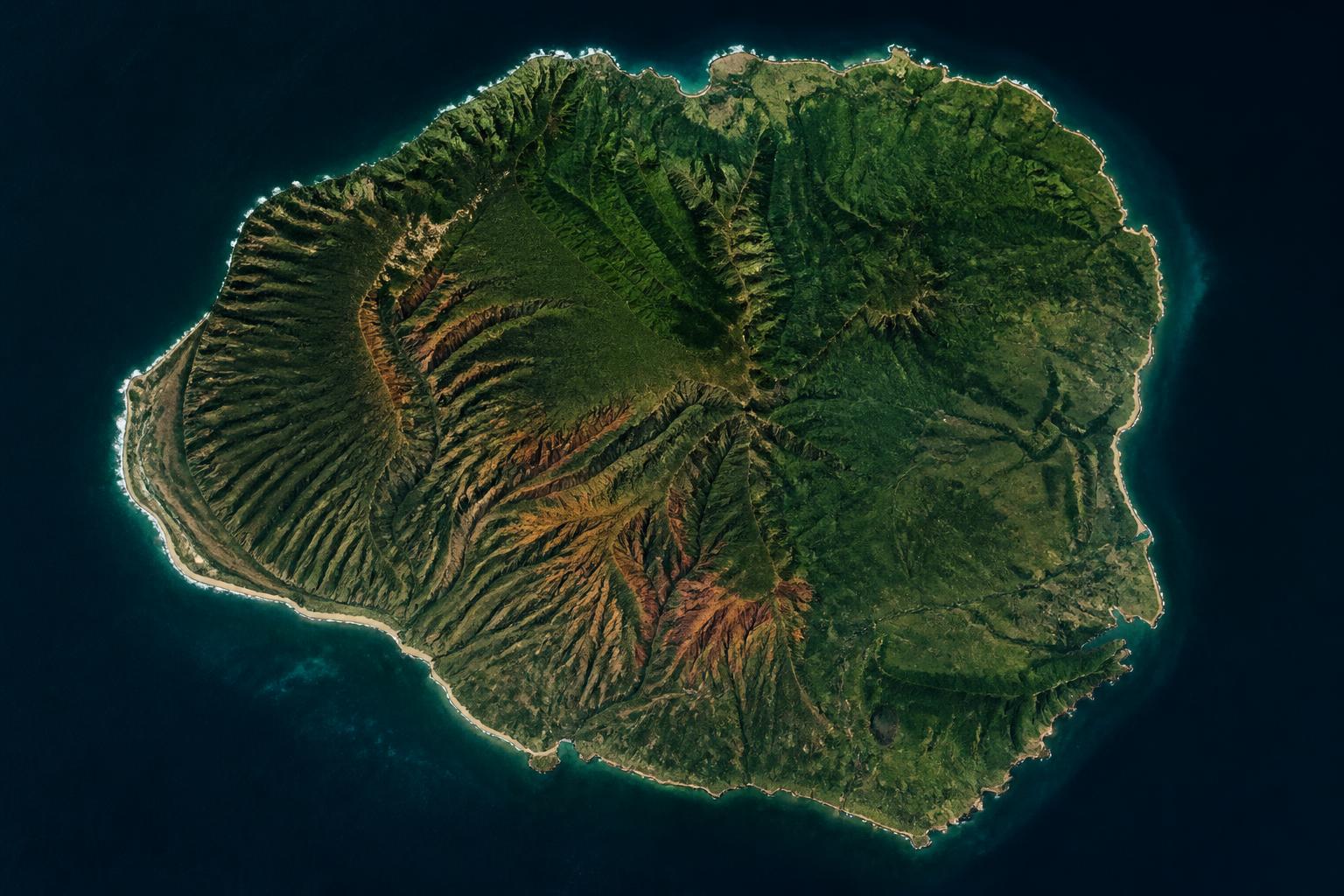
- Priority 1: Plan FirstPlanning urgency (not a legal deadline). Typically shoreline, stream, or drinking-water zones.
- Priority 2: Plan EarlyPlanning urgency (not a legal deadline). Typically high-density or impaired watershed.
- 2050 Statewide DeadlineEvery Hawaiʻi cesspool must be converted, upgraded, or connected to sewer by January 1, 2050 under Act 125.
Priority 1: Plan First
A planning-urgency category, not a legal deadline. Priority 1 typically includes cesspools closer to shorelines, perennial streams, wetlands, or drinking-water sources. To confirm the category for your parcel, use the Hawaiʻi Cesspool Prioritization Tool or contact the DOH Wastewater Branch.
Priority 2: Plan Early
A planning-urgency category, not a legal deadline. Priority 2 typically includes high-density residential zones and parcels in the broader watershed of impaired surface waters. To confirm the category for your parcel, use the Hawaiʻi Cesspool Prioritization Tool.
2050 Statewide Deadline
Under Act 125 and HRS 342D-72, every cesspool in the State of Hawaiʻi must be upgraded, converted to septic or IWS, or connected to sewer by January 1, 2050. This is the enacted, binding date.
The 4 IWS Options Under Hawaiʻi DOH
"IWS" (Individual Wastewater System) is DOH's umbrella term for any on-site wastewater treatment system that is not a cesspool and not connected to municipal sewer. Four configurations are permitted on Kauaʻi. Your percolation test, soil profile, lot slope, and depth to groundwater determine which one DOH will permit for your address.
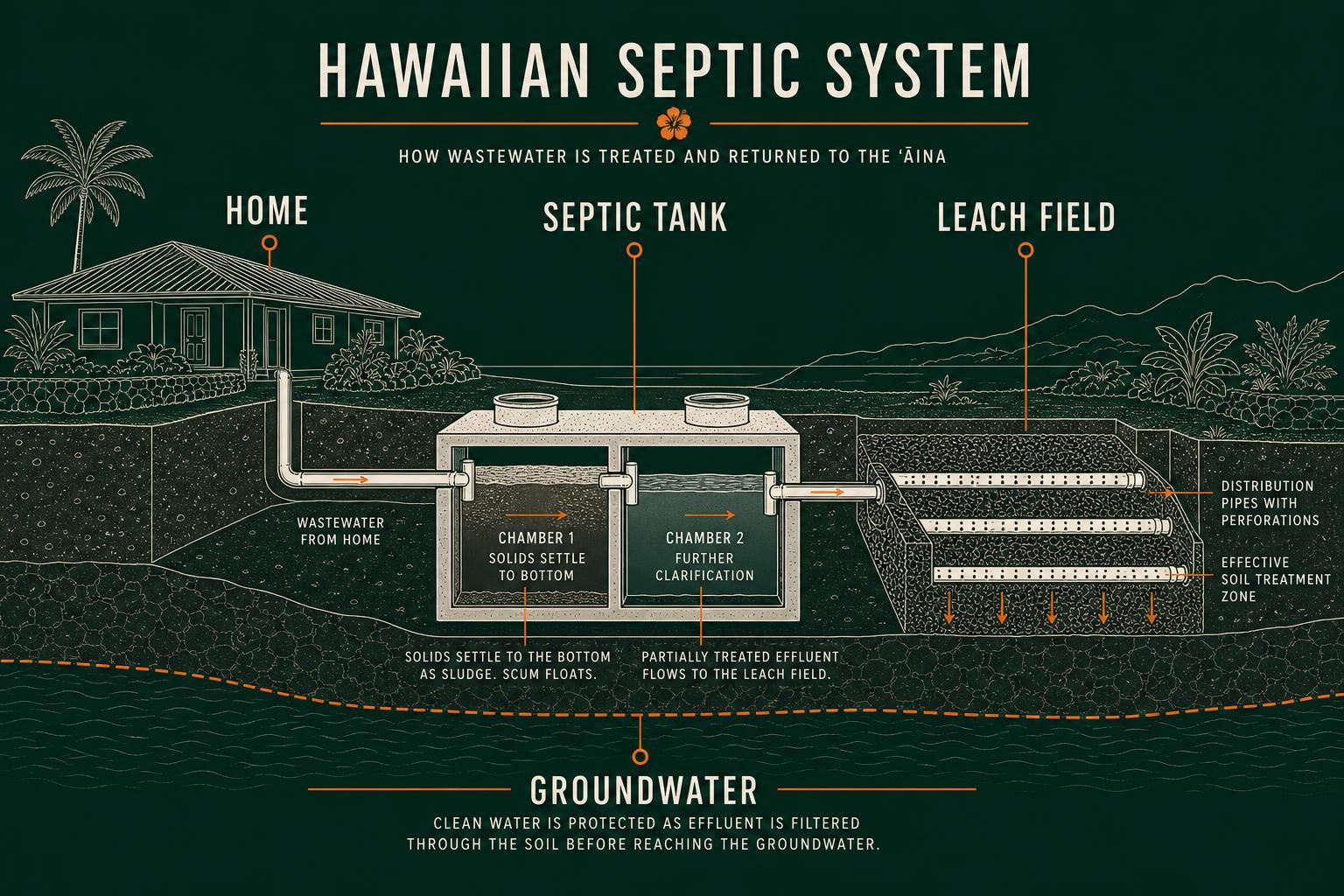
Wastewater from every fixture leaves the house through a single gravity waste line.
Two chambers let solids settle and scum float. Clarified effluent flows out the second chamber.
Perforated pipes disperse effluent through soil, DOH requires a minimum 3 ft to groundwater.
1. Conventional Gravity Septic
A septic tank separates solids and floats grease; effluent flows by gravity to a buried leach field where soil bacteria finish treatment. Best for lots with good percolation (15 to 60 minutes per inch), adequate slope, and standard setbacks.
2. Aerobic Treatment Unit (ATU)
A septic tank with active aeration that grows treatment bacteria fast and discharges much cleaner effluent. The leach field is smaller because the water leaving the tank is mostly treated. Required by DOH on many shoreline parcels. Requires an annual service contract.
3. Drip Dispersal
Treated effluent is pressure-distributed through small-diameter drip tubing across a shallow field, like slow drip irrigation. Best for shallow soil over rock (common on South Shore Kauaʻi), steep slopes, or properties where preserving landscape matters.
4. Elevated (Mound) System
When native soil cannot accept effluent (high groundwater, hardpan, or shallow rock), an engineered sand-and-gravel mound is built above grade to serve as the treatment medium. Common on Hanalei and Wailua floodplain parcels.
For the excavation, trenching, and tank-set side of any of these, see septic installation on Kauaʻi.
Permit Process and Timeline
Cesspool conversion on Kauaʻi crosses three desks: an engineer for the system design, DOH Wastewater Branch for the IWS permit, and your contractor for the installation. A realistic end-to-end timeline:
- Site Assessment
TMK check + priority tier confirmed
- Perc Test
Soil percolation measured on-site
- Engineered Design
Engineer stamps the plan
- DOH Permit
Wastewater Branch reviews + approves
- Install
Excavation, tank set, leach field
- Inspection
Final walk-through + backfill
- Week 1 to 2: Site assessment, TMK and DOH category check, percolation testing scheduled.
- Week 3 to 6: Percolation test results returned; engineered IWS design completed.
- After design: DOH Wastewater Branch permit application submitted.
- After submittal: DOH review could take up to several weeks.
- Construction window: a few days from break-ground to inspected and backfilled.
- Plan several weeks from first call to operational system. Start earlier if your parcel is in a Priority 1 category.
What Goes Into Your Conversion Estimate
Every Kauaʻi property is different. Soil conditions, slope, access, distance to the leach field, rock content, and the permitted system type all change the scope of work, which means we cannot honestly quote your conversion until we have walked your property.
What we promise:
- A free on-site assessment with no obligation.
- A clear, itemized written proposal within a few business days.
- Transparent line items so you can see exactly what you are paying for.
- No surprise change orders. If conditions change underground, we talk to you before we touch a thing.
Call (808) 855-DIRT to schedule your free site assessment.
Why Plan Ahead Instead of Waiting
Property sale
Title companies and lenders are increasingly flagging non-compliant cesspools at closing. Several Kauaʻi sales in 2025 stalled at the cesspool disclosure step. Converting before listing protects your sale price and your closing timeline.
Insurance
More homeowner-insurance carriers are starting to ask about wastewater system type on new policies and renewals, especially for coastal property. A new IWS is a better risk story than a legacy cesspool.
Permit queue and contractor availability
DOH Wastewater Branch review times are already lengthening as the 2050 statewide deadline approaches. Kauaʻi has a finite pool of IWS installers, and the months before that deadline are likely to see waitlists and rush-job premiums. The cheapest conversion is the one planned years in advance.
Grants and financing
The Kauaʻi County Residential Cesspool Conversion Grant Program closed September 27, 2024, and the State of Hawaiʻi cesspool conversion income tax credit has expired. We track program status on our grants and tax credits page. If financing is a concern, we can point you toward private lending resources we work with during your site assessment.
Cesspool Conversion Across Kauaʻi
We run cesspool conversions across every Kauaʻi town. Each parcel has its own soil, percolation, and access story, start with your town below.
- Cesspool conversion in Hāʻena
- Cesspool conversion in Wainiha
- Cesspool conversion in Hanalei
- Cesspool conversion in Princeville
- Cesspool conversion in Anini
- Cesspool conversion in Kalihiwai
- Cesspool conversion in Kīlauea
- Cesspool conversion in Moloaʻa
- Cesspool conversion in Anahola
- Cesspool conversion in Kealia
- Cesspool conversion in Kapaʻa
- Cesspool conversion in Wailua
- Cesspool conversion in Wailua Homesteads
- Cesspool conversion in Hanamāʻulu
- Cesspool conversion in Līhuʻe
- Cesspool conversion in Puhi
- Cesspool conversion in Kōloa
- Cesspool conversion in Poʻipū
- Cesspool conversion in Lāwaʻi
- Cesspool conversion in ʻŌmaʻo
- Cesspool conversion in Kalāheo
- Cesspool conversion in ʻEleʻele
- Cesspool conversion in Hanapēpē
- Cesspool conversion in Pakala / Makaweli
- Cesspool conversion in Waimea
- Cesspool conversion in Kōkeʻe
- Cesspool conversion in Kekaha
Frequently Asked Questions
Free On-Site Cesspool Assessment
We'll check your priority tier, review the access and soil story for your lot, and tell you which IWS options DOH is likely to approve, before you spend a dollar on testing.